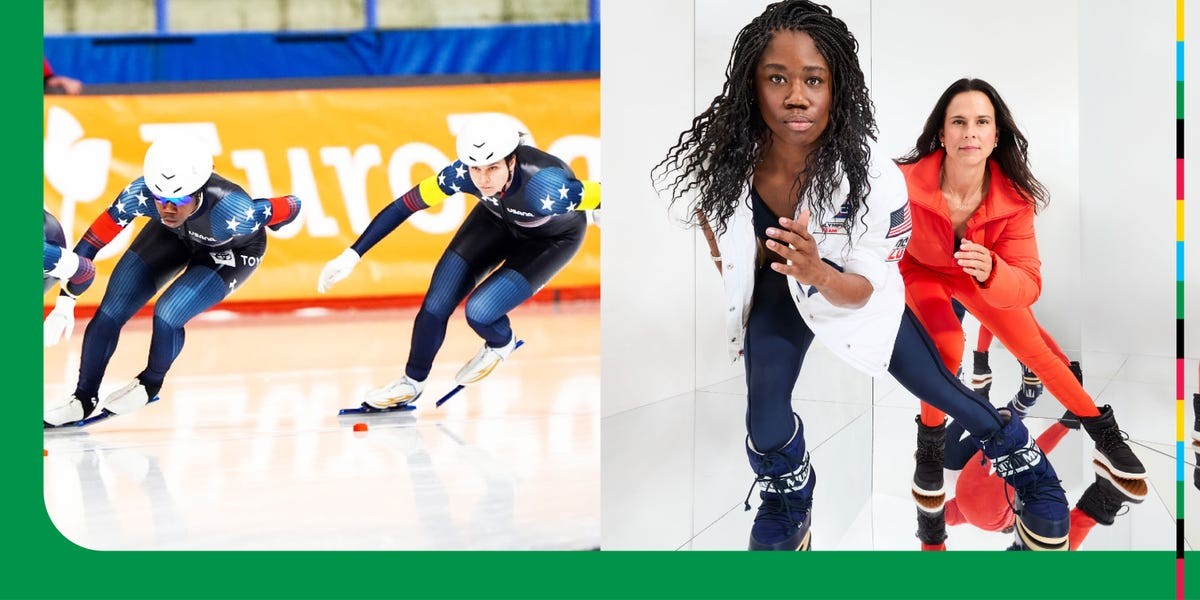
Two unlikely winter sports stars, Brittany Bowe and Erin Jackson, both from Ocala, Florida, are poised to compete at the 2026 Olympics. Their story is not just about athletic success, but about a decades-long friendship forged in roller rinks and refined on the ice. This unlikely pair represents a rising trend in sports: athletes defying geographic expectations and thriving in unconventional disciplines.
From Roller Rinks to Olympic Gold
Bowe, 37, and Jackson, 33, first met as teenagers at their local skating rink. Bowe was already a world champion in inline skating, while Jackson was a young up-and-comer. “She came up to about my chest—she was just a little one,” Bowe recalls.
Both athletes transitioned to speed skating through a Team USA program that recruits top inline skaters. The program has demonstrably worked: Bowe has earned two Olympic bronze medals and 22 World Championship medals, including seven gold. Jackson reached the pinnacle in 2022, winning gold in the women’s 500-meter event at the Beijing Olympics—making her the first Black woman to achieve this milestone in an individual Winter Olympic event.
A Bond Forged in Competition
Their journey wasn’t without hurdles. Bowe temporarily pursued basketball at Florida Atlantic University, while Jackson studied materials engineering at the University of Florida, also dabbling in roller derby.
However, the most remarkable moment of their partnership came at the 2022 Olympic trials. When Jackson slipped during a qualifying run, Bowe selflessly relinquished her spot to ensure her friend could compete. “If you ask Brittany, Erin was ‘far more deserving than I was in that event,’” underscoring their mutual respect.
The 2026 Games and Beyond
At the 2026 Olympics, Bowe and Jackson will compete in the 1000-meter event. Jackson will also defend her 500-meter title, while Bowe will focus on the 1500 meter. Their approach to competition is uniquely collaborative: “Until we’re at the top of the podium [as] one and two, we’re just trying to help each other get to that point.”
Mental Fortitude and Holistic Recovery
Both athletes credit their success to a blend of physical training and mental resilience. Jackson emphasizes a balanced perspective, refusing to define her self-worth by race outcomes. “If I have a bad race, it’s not the end of the world,” she says, while simultaneously pursuing degrees in kinesiology and business.
Bowe, at 37, attributes her continued competitiveness to cutting-edge recovery methods, including creatine, contrast therapy, hyperbaric chambers, and an infrared light sauna. She obsessively tracks her biometrics with an Oura Ring and Eight Sleep mattress.
This friendship isn’t just about medals; it’s a testament to mutual support, shared ambition, and the importance of maintaining a life outside of elite athletics. Their success underscores that even in the highly individualistic world of sports, collaboration and genuine connection can be the ultimate advantage.